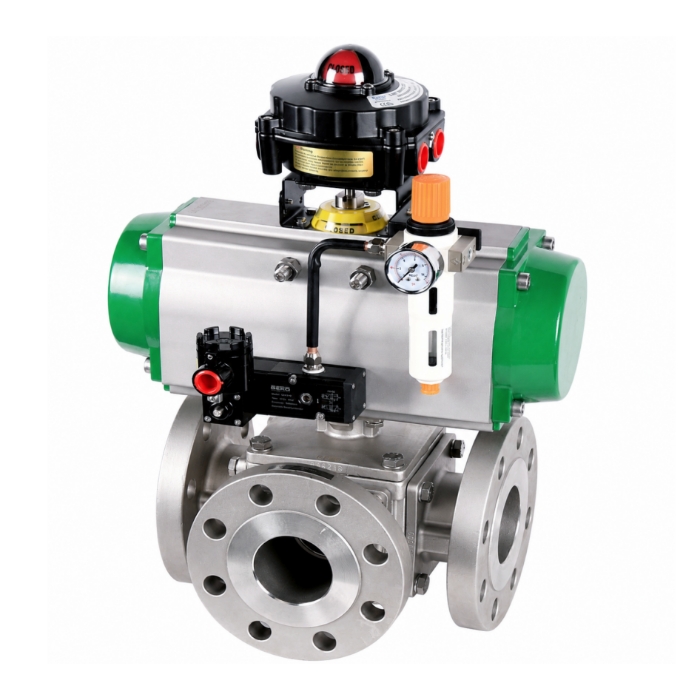
Turbine BDV Valve

Trang chủ

Turbine BDV Valve

  • GEKO Valves — Providing Precise and Reliable Control Solutions for Turbine Safety
    GEKO Valves — Providing Precise and Reliable Control Solutions for Turbine Safety
    Jun 10, 2026
    In steam turbine operation systems, VV valves, BDV valves, and RFV valves are all auxiliary protection and start-up control valves. Their names are similar, and their functions are highly related. Field operators are prone to conceptual confusion, functional misjudgment, and operational errors. This article systematically clarifies the core definitions, structural principles, interlock logic, operational requirements, and key differences of these three types of valves, based on turbine design principles, unit start-stop logic, and field operation standards, providing professional technical reference for operation, maintenance, commissioning, and overhaul. GEKO Valves, with their high-precision pneumatic control technology and rigorous industrial validation, have become a trusted brand in the manufacturing and system integration of these critical valves.     I. Core Valve Definitions & Structural Working Principles (i) VV Valve (Vent Valve — HP Exhaust Vent Valve) Located on the high-pressure (HP) exhaust pipeline, this special vent and pressure relief valve leads directly to the condenser and drain flash tank. It is mainly used in intermediate-pressure (IP) start-up units to solve windage overheating issues in the HP cylinder under low load or no-inlet steam conditions, while also providing rapid pressure relief after tripping to prevent overspeed.     During IP start-up or low-load operation, the HP cylinder has little or no inlet steam, and the HP exhaust non-return valve remains closed. The blades inside the HP cylinder generate significant heat due to air friction (windage), which can easily cause overheating damage to the HP blades and casing. After a turbine trip, residual steam in the HP cylinder can leak into the vacuum state of the IP cylinder through HP-IP shaft seals, creating a risk of rotor overspeed. The VV valve quickly evacuates residual steam from the HP cylinder to avoid these risks.   It uses a pneumatically controlled, air-to-close design, consisting of an air supply, cylinder, spring assembly, and solenoid valve. GEKO Valves features an optimized high-temperature spring assembly and low-friction cylinder in this product, ensuring reliable valve opening under air failure conditions, with solenoid valve response time ≤0.5 seconds, significantly improving the timeliness of windage overheating protection.     (ii) BDV Valve (Break Drain Valve — Turbine Emergency Drain Valve) An emergency pressure relief protection valve specifically designed for combined HP-IP turbines, also known as the HP-IP shaft seal residual steam dump valve. Its core function is to quickly discharge steam that leaks past shaft seals under unit load rejection or trip conditions, eliminating the risk of turbine overspeed.     During load rejection or emergency trip of combined HP-IP units, residual steam in the HP cylinder and HP inlet pipes can leak through the HP-IP shaft seal gaps into the IP and low-pressure (LP) cylinders, creating additional driving force on the rotor. If seal teeth are worn or gaps increase, the amount of leaking steam increases, significantly raising the risk of overspeed. The BDV valve directs this residual shaft seal steam directly into the condenser, quickly releasing pressure and completely blocking the overspeed path.   It uses an electromagnetic-pneumatic linkage structure, controlled by the stroke signal of the IP control valve oil servo. GEKO Valves' BDV product adopts a redundant dual-solenoid valve design with a highly reliable pneumatic control circuit, achieving full-stroke action within 0.3 seconds after the oil servo stroke signal is triggered, effectively preventing the escalation of overspeed accidents.   (iii) RFV Valve (Reheat Warm-up Valve — HP Cylinder Reverse Warming Valve) A dedicated warm-up control valve for cold starts, used to pre-heat the HP cylinder before cold start, eliminating casing temperature differences, reducing thermal stress, and ensuring the unit meets parameters for rolling.   During a cold start, the HP cylinder casing and internal components are at very low temperatures. Directly introducing steam for rolling would create huge thermal stress, leading to casing deformation, metal cracks, and excessive shaft vibration. The RFV valve introduces auxiliary steam upstream of the HP exhaust non-return valve. The steam flows evenly through the HP cylinder and is discharged through HP inner casing drains and HP inlet pipe drains, gradually raising the casing temperature to achieve uniform warm-up.   GEKO Valves has specifically developed an RFV valve with linear regulation characteristics for these operating conditions. It uses a low-leakage seal design and anti-seize valve core, allowing precise temperature control under low flow and low differential pressure conditions, with warming rate control accuracy of ±1.5°C/h, significantly outperforming conventional products.     II. Valve Interlock Control Logic VV Valve Interlock Logic Close Interlock: Receives stroke switch signals from the four HP control valve pre-pilot valves. When all four pre-pilot valves are fully open and unit steam flow reaches 0.5% BMCR, the VV valve automatically closes. 1 minute after unit grid connection, the HP exhaust non-return valve opens, and the VV valve closes via interlock.   Open Interlock: Automatically opens during initial IP start-up and low-load windage conditions. Immediately opens via interlock after turbine trip to quickly evacuate residual HP steam.   BDV Valve Interlock Logic Close Interlock: Controlled by IP control valve oil servo stroke. When oil servo stroke ≥30mm, or when the left/right IP control valve opening reaches 15%~16% (corresponding to ~5% flow command) and the pre-pilot valve is fully open, the BDV valve automatically closes.   Open Interlock: Automatically opens when IP control valve oil servo stroke <30mm. Quickly opens via interlock under turbine trip and load rejection conditions to discharge shaft seal steam.   Pre-Pilot Valve Function Note The turbine control valve pre-pilot valve is an auxiliary valve for the main valve disc. Before the main valve disc opens, the pre-pilot valve opens first, allowing new steam to flow through the pre-pilot passage, balancing the pressure differential across the main valve. This significantly reduces the force required to open the main valve, reduces the oil servo load, and avoids difficult or stuck valve opening.   III. Field Operation & Operational Requirements Pre-Start Check: Before unit start-up and rolling, the open/close status of VV and BDV valves must be confirmed both locally and via DCS. Never start the unit with abnormal valve status.   IP Start-Up Operation: Before start-up, confirm VV and BDV valves are open. If a manual isolation valve is installed upstream of the VV valve, check that it is fully open to avoid false action due to abnormal instrument air pressure or solenoid valve failure.   Post-Valve Transfer: After completing valve transfer following IP start-up, double-check (on DEH screen and locally) that the VV valve is fully closed to prevent steam leakage or pressure abnormalities after HP cylinder admission.   Unstable Conditions: During initial start-up, commissioning, or unstable operation, do not close the manual isolation valve upstream of the VV valve, leaving an emergency path available. After stable operation, close the manual isolation valve promptly.   Post-Trip Emergency: Immediately after a trip during operation, arrange personnel to locally check and open the manual isolation valve upstream of the VV valve, while verifying BDV valve position via DCS and locally, ensuring both valves open correctly for rapid pressure relief.   Normal Start-Stop: Monitor BDV valve position feedback in real-time after the interceptor valve opens during start-up and after a trip to ensure reliable interlock action.   Cold Start Warm-Up: Before rolling during a cold start, open the RFV valve for HP cylinder reverse warming. Monitor drain paths and casing temperature rise rate. Close the RFV valve after warm-up and proceed with normal start-up.   GEKO Valve Note: Accurate valve status feedback is critical in the above operations. GEKO valves come standard with high-precision limit switches and 4-20mA position transmitters, seamlessly integrating with DCS systems to significantly reduce misjudgment risks.     IV. Key Differences & Functions of the Three Valves     Valve Core Function Control Signal Source Main Application VV Valve HP cylinder venting, addresses windage overheating, auxiliary pressure relief after trip HP control valve pre-pilot stroke, steam flow, trip signal Initial IP start-up, low-load operation, turbine trip BDV Valve Discharges shaft seal steam, core overspeed prevention IP control valve oil servo stroke, IP valve opening signal Load rejection, emergency trip, IP valve not fully open RFV Valve HP cylinder cold pre-warming, reduces thermal stress Manual control + warm-up sequence Before turbine cold start     Key Functional Distinction:   VV Valve: Focuses on daily windage overheating protection; auxiliary pressure relief after trip.   BDV Valve: Core overspeed protection valve, specifically targeting shaft seal steam leakage.   RFV Valve: Only used for cold start warm-up, no accident protection function. These three functions are not interchangeable.   GEKO Valves has developed dedicated valve series for each of these three needs, with differentiated designs from material selection (e.g., high-temperature alloy seat for VV valve), sealing structure (metal hard seal + flexible graphite for BDV valve), to actuator configuration (smart positioner optional for RFV valve), ensuring the right valve for each application.   V. Shaft Seal & Stem Leakage System Summary (Typical Plant Configuration) Main Stop Valve: 1st stage leakage → sealing steam header, 2nd stage leakage → sealing steam return header   HP Control Valve: 1st stage leakage → reheater, 2nd stage leakage → sealing steam header   IP Interceptor Valve: Only 1st stage leakage → sealing steam header   BDV Valve: 1st stage leakage → reheater, 2nd stage leakage → sealing steam header   VV Valve: 1st stage leakage → 4th extraction pipe, 2nd stage leakage → sealing steam header   HP Shaft Seal: 3rd stage leakage → 4th extraction pipe   In the above system, GEKO Valves provides matching shaft seal leak control valves and stop valves, ensuring stable leak-off pressures, reducing steam waste, and improving unit thermal economy.   VI. Core Technical Q&A 1. What are the core functions of the VV valve and BDV valve? VV Valve: During IP start-up and low-load operation, connects the HP cylinder to condenser vacuum, evacuating air from the cylinder to reduce windage heating and avoid HP blade/casing overheating. After a trip, quickly releases residual HP steam, assisting in overspeed prevention.   BDV Valve: During a trip or load rejection, quickly discharges steam that leaks from the high-pressure side through shaft seal gaps into the IP cylinder, directly cutting off additional driving force. It is a critical overspeed prevention valve.   2. Why choose GEKO valves for these critical applications? GEKO Valves has over 20 years of experience in developing specialized valves for steam turbines. Our products hold ISO 15848-1 fugitive emission certification and SIL2 functional safety certification. The VV, BDV, and RFV series have accumulated over 100,000 hours of safe operation in multiple ultra-supercritical and subcritical units worldwide, with an action success rate exceeding 99.96%. GEKO provides full-cycle technical support — from valve selection and interlock logic optimization to field commissioning — helping power plants reduce unplanned outage risks caused by valve misoperation or failure to operate.     Conclusion VV, BDV, and RFV valves each play a distinct, non-interchangeable role in turbine start-up and protection. Operating and maintenance personnel must not only master their working principles and interlock logic but also pay attention to the quality and reliability of the valves themselves. GEKO Valves, with solid technical expertise and extensive field experience, provides high-performance, high-reliability products and complete solutions for these three valve types, helping power plants achieve safer and more efficient operation.   For specific valve selection and interlock settings, please refer to the OEM design drawings and actual site conditions. GEKO Valves offers tailored technical consultation.
    ĐỌC THÊM

để lại lời nhắn

để lại lời nhắn
Nếu bạn quan tâm đến sản phẩm của chúng tôi và muốn biết thêm chi tiết, vui lòng để lại tin nhắn tại đây, chúng tôi sẽ trả lời bạn sớm nhất có thể.
nộp

Trang chủ

Các sản phẩm

liên hệ